Oxygen vacancy-induced strengthening and toughening in (K,Na)NbO3-based piezoceramics revealed via nanoindentation
https://doi.org/10.1038/s41467-025-62424-3
A collaborative study between the Hubei University and Erich Schmid Institute of Materials Science, Austrian Academy of Sciences, Austria published in Nature Communications, reveals a breakthrough in enhancing the mechanical properties of lead-free piezoceramics. The research demonstrates how controlled introduction of oxygen vacancies can simultaneously improve both strength and toughness in potassium-sodium niobate (KNN)-based materials.
While KNN-based piezoceramics are crucial for sensors and transducers due to their excellent electromechanical properties and environmental friendliness, their inherent brittleness has limited practical applications. The research team employed nanoindentation technology to precisely characterize material properties at the micro-scale, bypassing the limitations of conventional testing methods.
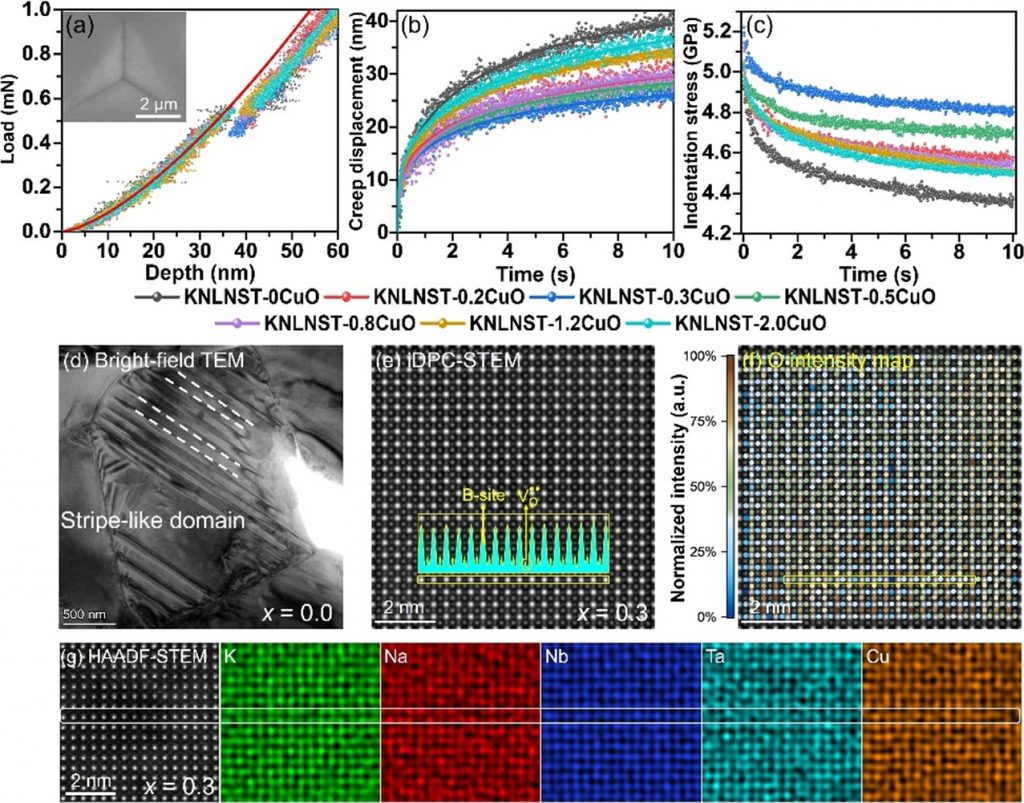
Through strategic doping with CuO, researchers successfully regulated oxygen vacancy concentration in the ceramics. Remarkably, introduced oxygen vacancies enhanced both hardness and fracture toughness. Density functional theory (DFT) calculations further revealed the underlying mechanism: oxygen vacancies lower the total misfit energy and the Peierls stress in KNN-based ceramics, facilitating easier dislocation nucleation and activation. This facilitates the solid solution strengthening and pinning effects between dislocations and oxygen vacancies, ultimately achieving comprehensive mechanical performance improvement.
This work, uncovering how oxygen vacancies affect dislocation behavior, opens new possibilities for developing reliable functional ceramics for advanced electromechanical applications.